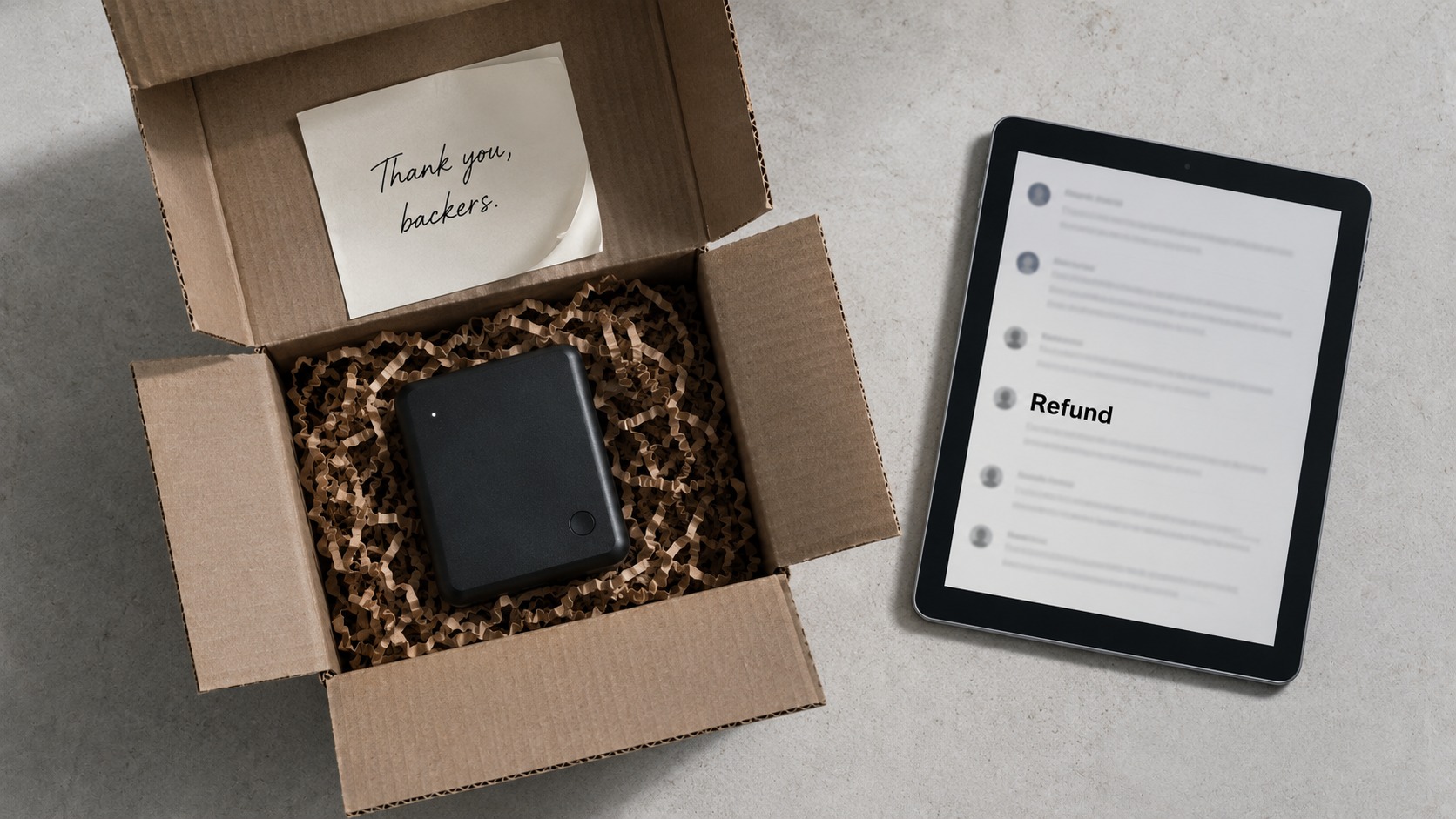
Crowdfunded creators get punished for quality problems twice.
The first hit is the same one any consumer brand takes: defective units, returns, one-star reviews. The second is specific to crowdfunding. It happens in public. Backers paid you nine months ago. They are refreshing the comments tab. They are posting in r/Kickstarter the moment something is wrong. The reputation damage compounds faster than a normal launch because the community is already paying attention and already invested.
This is not hypothetical. The pattern is familiar to anyone who has watched a crowdfunded category move from “successfully funded” to “shipping to backers” to “voluntary recall” in 18 months.
The good news: most of what eventually shows up as a quality failure in a shipped crowdfunded product is detectable months earlier (sometimes years earlier) by someone who has done QA reviews in regulated industries and knows the failure pattern of the category.
That is the gap a Pre-Launch QA Audit fills.
What “Risks and Challenges” doesn’t cover
Every Kickstarter project has a Risks and Challenges section. It is mandatory and creators take it seriously. It is also, by definition, a self-report. The creator describes the risks they know about. An independent QA review is built around the risks they don’t.
Patterns that almost never appear in a Risks and Challenges section but show up routinely in the federal recall feeds for the same product category:
- The supplier’s previous-generation product was recalled by CPSC for a related failure mode. The creator never checked.
- The category has a published voluntary safety standard (ASTM, UL, ISO) and the creator’s spec sheet doesn’t reference it anywhere.
- The product crosses a regulatory boundary the creator didn’t realize existed. A kitchen appliance with a sealed lithium cell triggers UL listing requirements. A baby product crosses age-grading thresholds. A wellness device makes a claim that pulls it into FDA scope. A garment marketed as kids’ apparel triggers 16 CFR 1610 flammability testing.
- The factory’s BOM uses a polymer appropriate for the prototype, but it degrades under thermal cycling at the temperatures the marketing copy promises.
- A category-wide one-star review cluster on Amazon points to a specific failure type, and the creator’s product uses the same component that drives it.
None of these patterns are exotic. All of them are catchable in a documentation review by a senior QA engineer with access to live federal recall data.
What an independent Pre-Launch QA Audit does
The QESaaS Pre-Launch QA Audit is a one-week documentation review at a fixed price, built specifically for the pre-manufacturing window. The methodology is published openly at qesaas.com/the-qa-audit. Ten categories. Applied transparently.
Materials, tolerances, and failure modes get read against your spec sheet, BOM, and prototype photos.
Manufacturer track record and category recall history are pulled from live CPSC, FDA, USDA, and NHTSA data pipelines. Those are the same pipelines that power RecallSentry™, our consumer recall app.
Regulatory exposure is mapped against your specific product, with explicit calls on what is table stakes and what is missing from your documentation.
One-star review patterns and warranty reality for two to three comparable products on market are aggregated and clustered by failure type.
The audit closes with a risk-ranked verdict. Findings sorted high, medium, or low, with specific evidence, a recommended action, and a yes / no / with-caveats recommendation on shipping as-is.
The deliverable is a 10 to 15 page PDF report, delivered within one week of kickoff, followed by a 30-minute review call.
What you send in: your spec sheet, your supplier documentation, prototype photos, and links to two or three competitor products on market. That is the loop.
The audit is not a factory audit. It is not destructive testing. It is not a regulatory filing. It is what a Fortune 500 product organization would call an internal QE pre-production review. The same gate, scaled to fit a creator with one product and a Kickstarter-sized budget.
Why the timing matters for crowdfunded creators
The pre-manufacturing window is the highest-impact point in a product’s life for catching quality problems. Once the PO is placed, every option gets more expensive.
Material substitutions become re-tooling. Spec changes start delaying a ship date you have already promised your backers. A regulatory compliance issue that surfaces after units are in a 3PL warehouse means rework or destroying inventory. A failure mode that surfaces after backers have units in hand becomes a public refund thread, a Kickstarter-comments meltdown, and a permanent search-result for your brand.
For non-crowdfunded launches, those costs are bad. For crowdfunded launches, they are catastrophic. Your most engaged customers are also your most public ones, and they will tell each other before they tell you.
Why an outside engineer sees what the creator can’t
Founders are subject-matter experts in their own product. That is not the gap. The gap is that no single founder has seen a thousand consumer products fail.
A senior QA engineer who has worked in regulated industries has. The same handful of failure modes recur in different categories under different brand names year after year. When that pattern recognition is layered on top of live federal recall data, creators get an answer they can’t get on their own. Has the specific thing I am worried about actually gone wrong, recently, in my category, at scale? The audit answers that question with citations and delivers them in a week, before the deposit clears.
The audit complements the founder’s expertise with a senior-engineer-plus-data layer the founder can’t build alone in the time they have.
Audit limitations and scope
The audit does not guarantee no recall. No audit on Earth does. It does not replace UL listing, FDA registration, or CPSC certification when those are legally required. Physical destructive testing is also outside scope.
The output is a senior engineer’s eyes on your documentation and your category’s federal failure data, calibrated to find what first-time creators miss.
For crowdfunded creators specifically, the alternative is finding the problem after units have shipped to backers. That alternative is meaningfully worse than for any other go-to-market channel.
How to engage
The first three Pre-Launch QA Audits are running at $750 in exchange for a written testimonial. Standard rate after those slots fill is $1,500, fixed price, one-week turnaround. Scoping calls are free, and if your product is not a fit, we will say so before any invoice goes out.
Service details and engagement: qesaas.com/services-pre-launch-audit
The 10-point methodology, in full: qesaas.com/the-qa-audit
If you are a creator preparing for manufacturing fulfillment, the highest-impact week of work you can buy is the one before the PO is signed.
Mark Mayeux is a senior quality engineer with 20+ years across medical devices, aerospace, automotive, and consumer goods. His background includes leading ISO 9001, ISO 14001, and OHSAS 18001 certification audits in regulated manufacturing, and building the quality department at a medical equipment startup that was later acquired. Today he runs QESaaS and is the founder of Center for Recall Safety LLC, which operates RecallSentry™ and the federal recall data pipelines that power the Pre-Launch QA Audit.
Want this kind of analysis on a product you're shipping or a regulatory situation you're sitting in? Email Mark or book a scoping call. Initial conversations are free and NDA-able.
← All articles